


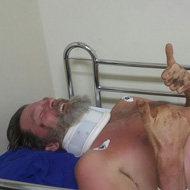
Illegal activities could be making the Mount Elgon elephants more nervous
World-renowned conservationist Ian Redmond OBE, has survived a near-fatal elephant charge in Western Kenya.
Redmond, who is a wildlife consultant for the Born Free Foundation, had been observing elephants at Mount Elgon National Park. Around 150 metres away, a herd was crossing a forest glade when one of the elephants turned and charged towards him.
Incredibly, he managed to capture some of the incident on camera.
Describing the moment of impact, Redmond said: "I was pushed into a high-speed backward roll and found myself momentarily upside down between his front legs with my feet touching his chest – and then completed the backward roll and landed on my hands and knees under his belly, facing his hind legs. I think he was trying to kick me into a position where he could either ‘kneel’ on me with his wrist or reach me with his trunk.
"My next clear memory was of my left hand on his right foreleg and my right hand, still clutching the camera, trying to steady myself. I could feel the soft, pliable skin and bristles against my palm – elephants do have hairy legs! I think I had either pushed myself or the elephant kicked me out from under his feet, and I landed on the grass to his left."
Rangers from the Kenya Wildlife Service fired shots into the air, causing the elephant to break away and retreat, saving Redmond's life. He survived the incident with a partially dislocated shoulder and soft tissue damage to his neck and chest.
Redmond has been monitoring the Mount Elgon elephants for 36 years, and he says this is the first time he has ever seen an elephant leave the group and run 150 metres to tackle a perceived threat.
The Mount Elgon elephants are a unique population - they feel their way hundreds of metres into huge caves, using their tusks to find and mine minerals deep underground.
But like many elephants in Africa, they face serious threats. At least eight of the small community were killed by poachers between 2012 and 2014. Charcoal burners are also active in the area, operating illegal charcoal kilns. It is thought these activities may be causing the elephants to become increasingly nervous and, in this case, aggressive.
Born Free have launched a new appeal to help protect the community and eradicate the illegal activities in their unique habitat.
Image © Ian Redmond


 Companies marketing medicines for small pets exempt from authorisation must submit their annual return to the Veterinary Medicines Directorate (VMD) by 30 November 2026.



