


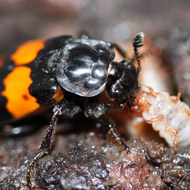
Fighters spend more time tending to their young
A study commissioned by The University of Edinburgh shows that female beetles with a greater history of conflict, make better mothers.
The study revealed that the offspring of beetles whom had engaged in more fights spent twice as much time tending to their young, ensuring a higher survival rate.
The study also showed that these female beetles made better mothers, regardless of whether they had won or lost. They laid the same quantity of eggs but more of their hatchlings survived to adulthood.
Female burying beetles regularly fight over the decaying bodies of rodents and small birds, in order to feed their young. Fighting indicates competition within the population to female beetles, signifying that opportunities to mate may be scarce and therefore forcing them to make more effort at each breeding attempt.
Natalie Pilakouta, of the University of Edinburgh’s School of Biological Sciences, who led the study, said: “Our findings show that fighting contests have much wider consequences than previously thought. We now know that fighting experience can affect parents' decisions about how much care to provide to their offspring.”
The team at Edinburgh University stated that in most species where fighting takes place, physical conflict often affects a mother’s reproductive decisions, in turn having an effect on her offspring.
The study, published in the journal The American Naturalist, was funded by the University of Edinburgh and Campus Hungary. The research was carried out in collaboration with the University of Debrecen, Hungary.
Image (C) Per Smiseth


 Companies marketing medicines for small pets exempt from authorisation must submit their annual return to the Veterinary Medicines Directorate (VMD) by 30 November 2026.



