


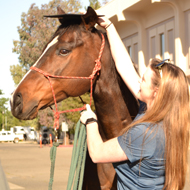
Gentle Teddy helped many students to learn about equine health
A thoroughbred horse has become 'Dr Teddy' after receiving an honorary degree from UC Davis School of Veterinary Medicine. Teddy has been described by students as "the perfect patient", helping them to learn about equine health over the past year.
While 137 human students received their Doctorate of Veterinary Medicine, 19-year-old Teddy was given his honorary degree for being a 'master equine educator'.
During a lengthy stay at the school's teaching hospital, Teddy had more than two dozen appointments and many students had the opportunity to learn from him. As well as having routine treatments such as vaccinations and deworming, he was seen for more complicated issues including a neurological disorder stem cell treatments.
Despite months of confinement, Teddy has a cheerful and patient disposition, which helped students with only minimal large animal experience to feel comfortable around horses. With an inherent interest in human companionship, Teddy was the perfect horse for students to approach.
For graduate Carin Stevens, he was the first patient she ever had on her clinical rotations. She said: "Signing up for your first patient is quite a nerve wracking experience as you try to figure out how to go through the motions of being a fourth-year student and integrating all of the medicine you have learned up to that point. Teddy was the perfect patient."
Teddy helped the students with various lessons in equine medicine, including neurologic assessment, lameness evaluation, administration of medication, behavioural and postural assessment, grooming and hand walking, to name a few.
"Teddy provided an exceptional educational service for staff, students, residents and faculty from many hospital services," said Dr Larry Galuppo, chief of the Equine Surgery and Lameness service. "His care truly touched so many".
His owners, Bob and Colleen Haas, were delighted by his award. "For Teddy to be the first equine to 'graduate' from UC Davis as a master equine educator is beyond comprehension," they added. "We're so grateful to everyone at UC Davis for Teddy's care."
Image © UC Davis


 Companies marketing medicines for small pets exempt from authorisation must submit their annual return to the Veterinary Medicines Directorate (VMD) by 30 November 2026.



