


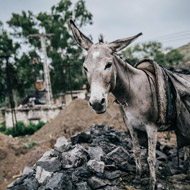
180 countries commit to undertake the recommendations
A set of global welfare standards for working horses, donkeys and mules have been approved by the World Organisation for Animal Health (OIE).
Some 180 countries will commit to the new guidelines, which were announced on Wednesday (May 25) at the World Assembly of OIE Delegates in Paris.
Standards for animal welfare exist for animals used in food production, but this is the first time that recommendations have been put in place for working equines.
They relate to food, water, shelter, equipment, handling, behaviour and the treatment of disease. The list also extends to care at the end of the equine’s working life.
Governments across the world will be responsible for enforcing the regulations alongside OIE’s other standards for animal welfare, although they will not be law.
Karen Reed, head of animal welfare capacity at the charity Brooke, was one of the key technical experts supporting the OIE while they developed the standards:
She said: “These standards represent the missing piece of the puzzle when it comes to animal welfare. At Brooke we often say that the horses, donkeys and mules of the world are the invisible workers, because in terms of their welfare, there is little being done at a government or international level. These standards will help us to change that.”
Brooke says that the next steps are to ensure that the standards are first adopted and understood but then properly implemented in member countries.
Fred Ochieng, head of Brooke East Africa, said: “This is indeed a dream come true. Having standards to protect horses and donkeys is long overdue. In many regions in East Africa, unless a donkey goes to work a family may not have any food to eat, a kid may not go to school or a pregnant lady may not have access to clinical services.
“Here, when you sit down to breakfast each morning, the bread or the coffee you have has probably at some point been transported by a working horse or donkey. That is how useful these animals are, and the reason why we must all care and protect them. The standards will help us do more for the animals.”
Image (C) The Brooke/Freya Dowson


 Companies marketing medicines for small pets exempt from authorisation must submit their annual return to the Veterinary Medicines Directorate (VMD) by 30 November 2026.



