
Your data on MRCVSonline
The nature of the services provided by Vision Media means that we might obtain certain information about you.
Please read our Data Protection and Privacy Policy for details.

In addition, (with your consent) some parts of our website may store a 'cookie' in your browser for the purposes of
functionality or performance monitoring.
Click here to manage your settings.
If you would like to forward this story on to a friend, simply fill in the form below and click send.

Your friend's email:
Your email:
Your name:
 
 
Send Cancel

New York plans to ban cat declawing
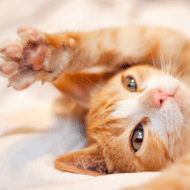
Ginger tabby
Cat declawing is illegal in Britain, Australia and several European countries.

US veterinary organisations oppose the ban

New York is planning to impose a ban on the declawing of cats, prompting a debate on whether the practice is inhumane.

If the legislation is passed, New York would become the first state in America to prohibit the surgery, which is comparable to having the tips of the fingers cut off at the first joint below the fingernail.

The law would not apply to treatment for a therapeutic purpose. For example to address a medical condition such as an existing or recurring illness, infection, disease or injury.

According to The Telegraph, veterinary organisations in America oppose a ban on declawing, often because it is the only way for cats with behavioural problems to keep from being abandoned or euthanised.

They say that such medical decisions should be left to professionals and cat owners, and not politicians.

“None of us love the procedure,” said Richard Goldstein, a veterinary surgeon at New York’s Animal Medical Centre. “But when the alternative is condemning the cat to a shelter or to death? That’s why we do it.”

Supporters of the ban say destructive clawing can often be dealt with through nail clipping, nail caps or scratching posts.

Jenner Conrad is a vet who travelled to the state of Albany this past week to lobby for the proposed ban.  She said: “It’s amputation. It is the equivalent of taking a cigar cutter and cutting the end joint off.”

Cat declawing is illegal in Britain, Australia and several European countries. The practice is also banned in Los Angeles and some other Californian cities.

It is estimated that around a quarter of all pet cats in America will be declawed in their lifetime.


Become a member or log in to add this story to your CPD history

Equine Disease Surveillance report released for Q4 2025

News Story 1
 The latest Equine Disease Surveillance report has been released, with details on equine disease from Q4 of 2025.

The report, produced by Equine Infectious Disease Surveillance, includes advice on rule changes for equine influenza vaccination.

Statistics and maps detail recent outbreaks of equine herpes virus, equine influenza, equine strangles and equine grass sickness. A series of laboratory reports provides data on virology, bacteriology, parasitology and toxicosis.

This issue also features a case study of orthoflavivus-associated neurological disease in a horse in the UK. 

Click here for more...
News Shorts
RCVS annual renewal fee for vets due

RCVS' annual renewal fee for veterinary surgeons is now due. Vets must pay their renewal fee before Wednesday, 1 April 2026.

This year's standard annual fee has increased to 431 from last year's 418. This is an approximately three per cent increase, as approved by RCVS Council and the Privy Council.

Tshidi Gardner, RCVS treasurer, said: "The small fee increase will be used to help deliver both our everyday activities and our new ambitious Strategic Plan, which includes aims such as achieving new legislation, reviewing the Codes of Professional Conduct and supporting guidance, and continuing to support the professions through activities such as the Mind Matters Initiative, RCVS Academy and career development."

A full breakdown of the new fees is on the RCVS website. Information about tax relief is available on the UK government website.

