


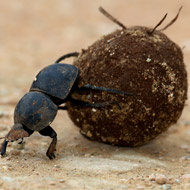
Action takes place when the insect dances on top of its ball
Dung beetles take a “celestial snapshot” of the sun, moon and stars and use that image to navigate, according to new research.
Like many insects, dung beetles rely exclusively on celestial clues to maintain their orientation. However, the mechanism that allows them to use these clues for navigation is unknown.
Previous studies suggests that insects rely on intuition to predict the natural geographical relationship between celestial clues.
But now a new study, published in the journal Current Biology, shows that dung beetles do not rely on this. Instead, they appear to take a mental “snapshot” of the celestial scene, ‘even if that scene represents a physical impossibility for the real sky'.
The researchers also found that the beetles are able to maintain their bearing with respect to the celestial clues, only if they are visible when the snapshot is taken. This celestial snapshot takes place when the beetle performs a dance on top of its ball of dung to rotate its vertical axis.
Researchers say that this strategy for reading celestial signals is a ‘simple but efficient mechanism for straight-line orientation’.
Speaking to BBC News, lead researcher Dr El Jundi from Lund University said: "In that situation they scan the sky and take a mental image of what the sky looks like and when they start rolling they try to match the actual visual scenery of the sky with the mental image they have stored before. And that brings them away in a straight line.”
Dr Jundi adds that their findings could help in the human development of driverless vehicles.
"Based on these results you could create robots or algorithms that could be incorporated into autonomous vehicles that could navigate without cues that humans input into the system," he said.


 Companies marketing medicines for small pets exempt from authorisation must submit their annual return to the Veterinary Medicines Directorate (VMD) by 30 November 2026.



