
Your data on MRCVSonline
The nature of the services provided by Vision Media means that we might obtain certain information about you.
Please read our Data Protection and Privacy Policy for details.

In addition, (with your consent) some parts of our website may store a 'cookie' in your browser for the purposes of
functionality or performance monitoring.
Click here to manage your settings.
If you would like to forward this story on to a friend, simply fill in the form below and click send.

Your friend's email:
Your email:
Your name:
 
 
Send Cancel

Pets rescued in wake of Canadian wildfires
Wildfires
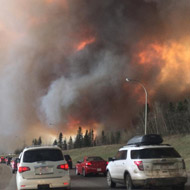
Residents in Fort McMurray were forced to evacuate the city last Tuesday.

Over 80 rescue groups open their doors to evacuee’s pets

Emergency teams in Alberta, Canada, are working to rescue abandoned pets in the wake of the devastating Fort McMurray wildfires.

Despite major damage and thick smoke, the Regional Municipality of Wood Buffalo, which oversees the city, said that it was sending teams in to rescue pets at their owner's request.

Among those enlisted to help is locksmith Kevin Wonitowy, who will break into homes where animals are trapped inside.

Speaking to Reuters, Mr Wonitowy said he would be needed for three to four days in the nearly empty city that was once home to 88,000 pets.

Another rescue worker, Angel Rowe of Leduc, Alberta, said he organised a convoy to Fort McMurray on Friday. Mr Rowe said the convoy would be stationed outside the city to transport the rescued pets to animal shelters.

According to a local non-profit website, over 80 animal rescue groups have opened their doors to evacuee’s pets so far. But sadly, reunification with owners may still be some time off.

Tammy Dumais, who runs the Guardian Angel Animal Rescue Society in Edmonton, said that even people who brought their pets with them during evacuation ended up unable to take care of them.

She added that at least 11 cats have been handed over to her organisation by owners fleeing south.

Residents in Fort McMurray were forced to evacuate the city last Tuesday (3 May) with little warning.

Access has since been restricted, and many owners who left their pets behind have been calling on animal shelters and appealing for information online.

Image (C) DarrenRD/Wikimediacommons

Become a member or log in to add this story to your CPD history

Equine Disease Surveillance report released for Q4 2025

News Story 1
 The latest Equine Disease Surveillance report has been released, with details on equine disease from Q4 of 2025.

The report, produced by Equine Infectious Disease Surveillance, includes advice on rule changes for equine influenza vaccination.

Statistics and maps detail recent outbreaks of equine herpes virus, equine influenza, equine strangles and equine grass sickness. A series of laboratory reports provides data on virology, bacteriology, parasitology and toxicosis.

This issue also features a case study of orthoflavivus-associated neurological disease in a horse in the UK. 

Click here for more...
News Shorts
RCVS annual renewal fee for vets due

RCVS' annual renewal fee for veterinary surgeons is now due. Vets must pay their renewal fee before Wednesday, 1 April 2026.

This year's standard annual fee has increased to 431 from last year's 418. This is an approximately three per cent increase, as approved by RCVS Council and the Privy Council.

Tshidi Gardner, RCVS treasurer, said: "The small fee increase will be used to help deliver both our everyday activities and our new ambitious Strategic Plan, which includes aims such as achieving new legislation, reviewing the Codes of Professional Conduct and supporting guidance, and continuing to support the professions through activities such as the Mind Matters Initiative, RCVS Academy and career development."

A full breakdown of the new fees is on the RCVS website. Information about tax relief is available on the UK government website.


