


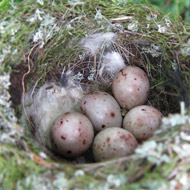
Some species able to adjust egg-laying times
A study of four British woodland birds has revealed that flexible nesting times may help them to cope with climate change.
Working with the British Trust for Ornithology, researchers at the University of Edinburgh have shown that the birds are able to adjust their egg-laying times in response to rising temperatures.
The researchers say that this flexibility may enable the birds to continue to lay at the optimum time as climate changes.
In the study, the researchers combined 100,000 observations of blue tits, chaffinches, great tits, and pied flycatchers with daily temperature records covering the same period.
The birds appeared to be well equipped to cope with seasonal temperature changes brought about by climate change.
The team say that even if spring temperatures rise rapidly in coming years, the species’ ability to adjust their nesting times could help them to survive.
"We know that birds use spring temperatures to adjust the timing of egg-laying, and the big question is whether this flexibility will allow birds to lay at the right time under future warmer conditions," said Dr Ally Phillimore, of the University of Edinburgh's School of Biological Sciences.
“For these four woodland species we suggest this flexibility in the timing of egg-laying does an excellent job of tracking variation in optimum timing.”
The timing of egg laying is crucial as it affects how much food is available to chicks after they hatch.
For over fifty years birdwatchers have recorded the first egg-laying dates of British birds and submitted them to the British Trust for Ornithology.
The study team warn that their conclusions are sensitive to how spring temperature cue is defined and further research is needed to make more accurate predictions about how birds may adjust to climate change.
The study is published in the journal Global Change Biology.
Image (C) University of Edinburgh


 Companies marketing medicines for small pets exempt from authorisation must submit their annual return to the Veterinary Medicines Directorate (VMD) by 30 November 2026.



