


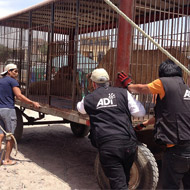
Rescued following ban on use of wild animals in circuses
Over thirty lions suffering from abuse and neglect in South America will be flown home to freedom on Friday (29 April).
Rescue organisation Animal Defenders International (ADI) say that 33 lions, 24 from circuses in Peru and nine from Colombia, are heading back to their homeland after both countries banned the use of wild animals in circuses.
Following years of abuse, the lions can look forward to large natural enclosures, water pools and toys at the the Emoya Big Cat Sanctuary, South Africa.
“These lions have endured hell on earth and now they are heading home to paradise,” commented ADI president Jan Creamer. “This is the world that nature intended these animals for. It is the perfect ending to ADI’s operation which has eliminated circus suffering in another country.”
Peru and Columbia banned the use of wild animals in circuses following an investigation into circus animal suffering and a long campaign by ADI.
In efforts to endorse the prohibitions - and to crack down on illegal wildlife trafficking - ADI have already rescued and relocated over 100 animals from Peru including bears, monkeys and birds.
Of the lions, 24 were rescued in surprise raids on circuses in the country. They were living in deplorable conditions in cages on the backs of trucks. Nine were voluntary surrendered by a circus in Colombia.
Almost all of the rescued lions had been mutilated to remove their claws. One has lost an eye, another is almost blind, and many have smashed and broken teeth so would not survive in the wild.
“The lions are returning to where they belong,” said Savannah Heuser, founder of Emoya Big Cat Sanctuary. “This is their birth right. African sun. African night skies, African bush and sounds, clouds, summer thunderstorms, large enclosures in their natural setting where they can remember who they are.
“The sad reality is that many rescued animals are simply replaced by the next litter of cubs, for the next money-making scheme, we love being part of this rescue that ends the abuse. Knowing that ADI has changed laws means that these lions are the last to be exploited in this way in Peru.”
An online campaign has already helped to raise over half the airfare required to bring the lions home.
A cargo plane will collect the lions on Friday, when they will be flown to Johannesburg under the watchful eye of ADI.
Image (C) ADI


 Companies marketing medicines for small pets exempt from authorisation must submit their annual return to the Veterinary Medicines Directorate (VMD) by 30 November 2026.



