


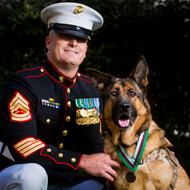
Lucca lost her leg protecting allied troops
A heroic US Marine dog who lost her leg helping to protect allied troops in Afghanistan has been awarded the PDSA Dickin Medal - also known as the animal's Victoria Cross.
During her six years of active service, the now-retired search dog Lucca completed more than 400 missions, protecting thousands of troops.
Such were her skills as a specialised search dog - trained to sniff out explosives and munitions - there were no human casualties during any of her patrols, despite the fact that she and her handler led 75 patrols in Helmand Province, Afghanistan, an area heavily burdened with improvised explosive devices (IEDs).
Lucca trained with Gunnery Sergeant Christopher Willingham and the pair served in two tours of Iraq together, during which time the search dog found weapons caches, IEDs and bombs, and was directly responsible for the capture of four insurgents during an operation in 2008.
Three years later she was deployed to Afghanistan where, alongside her new handler Corporal Juan Rodriguez, she led patrols to ensure the safety of troops behind. Despite being targeted with gunfire on several occasions the pair successfully continued their search for IEDs.
During her last ever patrol, Lucca signalled a haystack where a weapons cache was discovered. After the patrol resumed she indicated a 30lb pressure plate IED which was successfully located and cleared so the patrol could continue.
Lucca was then sent to clear a nearby path when another 30lb pressure plate IED detonated beneath her, causing the instant loss of her front left leg and severe burns to her chest, neck and head. Cpl Rodriguez carried out life-saving first aid on the dog and stayed by her side throughout her recovery - even sleeping next to her.
"The explosion was huge and I immediately feared the worst for Lucca," said Cpl Rodriguez. "I ran to her and saw her struggling to get up. I picked her up and ran to the shelter of a nearby tree line; applied a tourniquet to her injured leg and called the medics to collect us.
"I stayed with her constantly throughout her operation and her recovery. She had saved my life on so many occasions – I had to make sure that I was there for her when she needed me."
Lucca was eventually transported to Marine Corps Base, Camp Pendleton, California, to complete her recovery. Despite the treatment and the pain she was in, her handler says her temperament never changed. Within 10 days of her injury, she was up and walking. "Her fighting spirit was plain to see," Cpl Rodriguez added.
The PDSA's director general Jan McLoughlin presented Lucca with the Dickin Medal during a ceremony at Wellington Barracks, London. She is the only US Marine dog to ever receive the award, which is the highest honour an animal can receive whilst serving in military conflict.
By her side when she received the medal was her owner GySgt Christopher Willingham, who adopted her during her rehabilitation. She now lives with him and his family in California.
Explaining what Lucca means to him, GySgt Willingham said: "She is the only reason I made it home to my family and I am fortunate to have served with her.
"In addition to her incredible detection capabilities, Lucca was instrumental in increasing morale for the troops we supported. In between missions, I took the searching harness off and let her play and interact with the troops.
"Due to her personality, demeanor and proficiency as a search dog, Lucca made friends wherever she went. Today, I do my best to keep her spoiled in her well-deserved retirement."
Image © PDSA


 Eligible members of BEVA will be able to vote for their Council team until Monday, 17 August 2026. Members will have received an election email on 17 July.



