


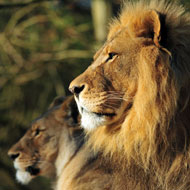
Community conservancies helping lion populations in Kenya
New research by the University of Glasgow has found that humans and lions can coexist through the creation of ‘community conservancies’.
Community conservancies are privately protected areas that engage local people in conservation and ecotourism.
They give households a share of the income generated from tourism and engender an attitude of coexistence with wildlife. But until now, their benefit for protecting large carnivores has been largely unknown.
In the study, published in the Journal of Applied Ecology, researchers set out to answer the question ‘are there any scenarios in which lions can live alongside people and their livestock?'
There has been a dramatic decline in lion populations in nearly all the areas where lions and people overlap, indicating that habitat fragmentation and human wildlife conflict has been a major driver behind this loss.
But researchers found that in the Masai Mara ecosystem, lion populations have increased substantially over the last decade, and that the creation of community conservancies has had the greatest impact on lion survival.
“The most important finding in this study is that community conservancies are a viable way to protect wildlife and pose an alternative solution to building fences,” explained study co-author Dr Grant Hopcraft.
“If we are concerned about the population of lions, we need to let the people who actually live with the lions benefit from their existence.”
The study concludes that conservancies are a good strategy for the future protection of lion populations and provide a practical solution to the problem, especially in areas where the expense of fencing is not a realistic option.


 Companies marketing medicines for small pets exempt from authorisation must submit their annual return to the Veterinary Medicines Directorate (VMD) by 30 November 2026.



