


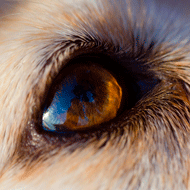
Further investigation could lead to a treatment for cell death
A canine blindness study led by US vets has revealed how retinal cells regenerate before they die.
Until recently, scientists believed that retinal neurons did not regenerate - which is why the outlook for nerve damage is considered to be so dire. But a finding in 2011 by researchers at the University of Pennsylvania disproved this.
They showed that in early retinal degeneration (ERD), retinal cells continue to differentiate for a period of time in a dog’s life before the cell death caused the retina to degenerate.
Now, a new study led by the Penn School of Veterinary Medicine has expanded on the research to consider two other forms of blindness - progressive retinal atrophy and rod cone dysplasia 1.
The results, published in the journal BMC Genomics, show that these diseases also possess the same feature of temporarily rejuvinating retinal cells, suggesting that it may be common across many forms of blindness.
ERD is an inherited disease which leaves dogs sightless within a year of birth. In the initial study, vets found that photoreceptor cells in the retina continued to divide when the animals were between seven and 14 weeks of age.
In the second study, the team set out to discover whether retinal cells were proliferating and, if they were, what specific types of cells were doing so.
Using chemical markers that label cells going through division, along with markers that only tag rod cells, the researchers observed “beautiful labelling”.
“To our great surprise, in these other two diseases we also saw a period of cell proliferation,” said researcher Gustavo Aguirre.
A further experiment ruled out the possibility that the same cells that were proliferating were also then undergoing cell death.
“We wanted to make sure that these weren’t some aberrant cells that were expressing all these different markers,” Gardiner said. “We showed that there appears to be a distinct population of rod cells that is proliferating and another that is dying.”
The team say that further investigation could lead to treatment that interferes with cell death and retinal degeneration in the diseases studied, as well as many other forms of inherited blindness.


 Eligible members of BEVA will be able to vote for their Council team until Monday, 17 August 2026. Members will have received an election email on 17 July.



