


New imaging technique could aid earlier diagnosis
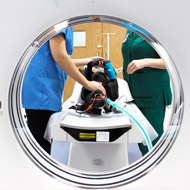
The team hope their approach could one day help to improve patient scans.
A technique for visualising tissues that could aid diagnosis and treatment of disease has been described in a new study.
Published in Nature Communications the new approach has been developed by researchers at the University of Edinburgh’s MRC Centre for Inflammation Research.
The technique is more sensitive then existing tools and could help researchers detect illness at a much earlier stage.
In the study the team created probes that that light up specific targets inside a cell.
The probes are made up of a short molecule called a peptide - which recognises the target trying to be detected - attached to a new type of fluorescent tag.
Researchers can then track this tag using microscopes to see where the target is being produced in the cell.
Because the new probes are more sensitive than existing probes, researchers will be able to quantify exactly how much of the target is produced by the cell.
This will help them to detect changes in the molecular make-up of tissues that could be the early warning sign of a disease.
Tracking these changes over time may also offer insights into how well a patient is responding to treatment.
“Peptides are a powerful tool for spotting small signs of disease but until now we did not have a good way of tracking them,” said Dr Marc Vendrell, a lecturer in biomedical imaging at the MRC Centre for Inflammation Research.
“With this new technology, we can make probes to detect diseases with more accuracy and at earlier stages.”
The team hope their approach could one day help to improve patient scans so that disease can be picked up faster using clinical imaging.


 Companies marketing medicines for small pets exempt from authorisation must submit their annual return to the Veterinary Medicines Directorate (VMD) by 30 November 2026.



