


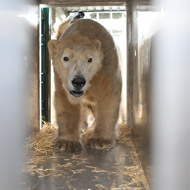
Keepers place transportation crate in male enclosure
Preparations have begun at RZSS Highland Wildlife Park to allow a male polar bear to meet a female polar bear for the first time.
The move is the latest step in the Park’s efforts to support the European breeding programme for this at-risk animal, which is currently listed as vulnerable on the IUCN Red List of Endangered Species.
Keepers have placed a large crate into the enclosure of eight-year old Arktos, a male polar bear who has resided at the Park since 2012.
Over the next couple of months, the keepers will use positive reinforcement training and food to habituate Arkos into the crate. Once comfortable, they will then transport him one mile across the park to 18-year-old’s Victoria’s enclosure.
Douglas Richardson, head of living collections at RZSS Highland Wildlife Park, explains: “When we first take Arktos to Victoria, he will live in a separate enclosure adjacent to hers. The two bears will be able to communicate and interact through a secure large fence to start with. We fully expect to see them showing an interest in each other right away.
“As with any introduction of large predators, the process must be approached slowly and carefully, paying close attention to positive behavioural indicators, like vocalisations and body posture. Whether we wait until Victoria comes into full breeding condition before mixing them together will depend on how they react to each other in the build-up to that key point."
Helping to protect the future of polar bears is no easy task, as the loss of sea-ice due to climate change is a primary threat to the species.
Research shows huge uncertainty for polar bears in the wild. Experts believe that the global population could decline by over 30 per cent in just three generations if sea-ice loss continues as projected.
“The shrinking polar ice-cap and shortening polar ice season has pitched the species to the forefront of conservation concerns,” Richard added. “In an ideal world, conservation would happen first and foremost in the wild, but unfortunately this is not the scenario we are dealing with."
Image (C) Highlands Wildlife Park.


 Companies marketing medicines for small pets exempt from authorisation must submit their annual return to the Veterinary Medicines Directorate (VMD) by 30 November 2026.



