


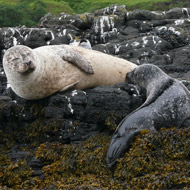
Strains similar to those found in humans
A study by the Moredun Institute has found strains of Salmonella in Scottish grey seals which are similar to those found in livestock and humans.
Published in the journal Environmental Microbiology, the study compared Salmonella isolated from grey seals with strains isolated from humans, livestock, wild mammals and birds.
Analysis of the strains found close similarities with those found in terrestrial mammals, including humans and cattle, alluding to possible concerns of environmental pollution from activities such as farming and sewerage discharge.
Dr Johanna Bally of the Moredun Research Institute, explains: “Finding these Salmonella isolates in large marine mammals along our coastlines raises concerns of land-sea transfer of both human and livestock pathogens. We need to know more about how these bacteria have spread to the marine environment and what threat they represent for our native marine mammals”.
In the study, researchers found salmonella present in over a fifth of all seal pups sampled. Of those sampled, live pups exposed to sea water were found to be almost four times more likely to carry salmonella compared to those not exposed to sea water.
The three types of Salmoella found were: S. Bovismorbificans which is occasionally found in cattle; S. Typhimurium which is similar to a type found in garden birds; and S. Haifa which is also found in humans.
The research paper: “Salmonella infection in grey seals (Halichoerus grypus), a marine mammal sentinel species: Pathogenicity and molecular typing of Salmonella strains compared with human and livestock isolates”, can be found at http://onlinelibrary.wiley.com/doi/10.1111/1462-2920.13219/abstract.
Image (C) Nevit Dilmen


 Companies marketing medicines for small pets exempt from authorisation must submit their annual return to the Veterinary Medicines Directorate (VMD) by 30 November 2026.



