


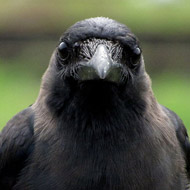
Tool used to hunt for insects and prey
Scientists have used tiny 'spy cameras' to capture wild New Caledonian crows in the act of making and using hook-shaped tools to hunt for insects and prey.
Dr Christian Rutz, from the University of St Andrews and Dr Jolyon Troscianko, from the University of Exeter, have captured the first video recordings documenting how these birds create these complex tools in the wild.
To obtain a crowe's-eye view of this elusive behaviour, the researchers developed video cameras that could be attached to the bird's tail feathers.
The cameras weigh about as much as a two pound coin, and a tiny integrated radio beacon lets the scientists recover the device once they have safely detached after a few days.
On two occasions the researchers captured the crows making the hook, with one spending a minute making the tool, before using it to look for food in tree crevices and leaf litter.
Commenting on the findings, Dr Troscianko said: “The behaviour is easy to miss – the first time I watched the footage, I didn’t see anything particularly interesting. Only when I went through it again frame-by-frame, I discovered this fascinating behaviour. Not once, but twice!”
“In one scene, a crow drops its tool, and then recovers it from the ground shortly afterwards, suggesting they value their tools and don’t simply discard them after a single use."
He continued: “Crows really hate losing their tools, and will use all sorts of tricks to keep them safe. We even observed them storing tools temporarily in tree holes, the same way a human would put a treasured pen into a pen holder.”
New Caledonian crows are found on the South Pacific island of New Caledonia and are able to fashion twigs and leaves into insect-grabbing devices using their bills. The skill is thought to be so advanced that it rivals that of some primates.
The findings are published in the journal Biology Letters.


 Companies marketing medicines for small pets exempt from authorisation must submit their annual return to the Veterinary Medicines Directorate (VMD) by 30 November 2026.



