


Pig industry 'should move away from farrowing crates'
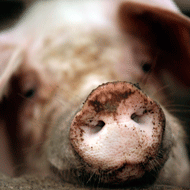
Confinement aims to protect piglet life but also reduces sow mobility.
The pig industry should replace traditional farrowing crates with free farrowing systems, according to a recent 'opinion' report by the Farm Animal Welfare Committee (FAWC).
For the past 50 years, the UK's indoor pig industry has been reliant on the close confinement of sows during the farrowing and lactating period. Systems for doing so without confinement have only recently been commercially adopted.
The aim is to protect piglet life by reducing the amount of crushing, as sows weigh around 150 times that of their offspring. It also makes sows and litters easier to handle and improves safety for stock people.
However, this may conflict with sow welfare as it reduces mobility and prevents normal behaviour such as nest building.
According to FAWC's report, nest building is an important behaviour, but is not possible in many confined farrowing systems.
Farrowing crates have already been banned in Norway, Sweden and Switzerland. Other European countries are developing and marketing free farrowing systems and there is interest in Australia and the US.
A number of commercial producers and smallholders in the UK have installed free farrowing systems. Some assurance standards, such as RSPCA Assured, require sows to be able to turn around freely at all times.
The 1965 Brambell Report on livestock welfare envisaged confinement of a few days, but this has extended to a few weeks (covering the whole farrowing and lactating period).
In its report, FAWC recommends a change in the way sow accommodation is viewed and considered, reflecting this change in management practices. It also calls for a review in five years' time, at which point legislation to phase out crates could be considered.
FAWC also recommended that producers increase direct supervision during farrowing and the post-farrowing period, to reduce piglet mortalities.
Read the full report here: https://www.gov.uk/government/publications/farm-animal-welfare-committee-fawc-opinion-on-free-farrowing-systems


 Companies marketing medicines for small pets exempt from authorisation must submit their annual return to the Veterinary Medicines Directorate (VMD) by 30 November 2026.



