


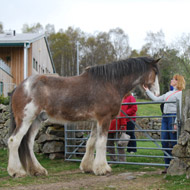
Digger stands at a whopping nine foot tall
One of Europe's tallest horses has taken the lead role in World Horse Welfare's new television and online advertising campaign.
Gentle giant rescue horse Digger was chosen to promote the charity's rejuvenated Adopt-a-horse scheme.
In the advert, Digger, voiced by actor Alex Norton, tells the stories of his stablemates rescued by World Horse Welfare and explains the benefits of adopting a horse from the charity.
World Horse Welfare director of fundraising, Emma Williams, commented: “When we were thinking about the perfect horse to front our new TV advert we knew that Digger had to be the first choice.
"He’s already developed a somewhat celebrity status through his incredible size and wonderful nature so turning his (massive) hooves to television advertising seemed like the next natural step in his career!"
Digger stands at an enormous nine foot from the ground to the tips of his ears. He arrived at Belwade Farm Rescue Centre in Aberdeenshire as a four-year-old in 2007 after his owners contacted World Horse Welfare. They were struggling to cope due to their own poor health and Digger's rapidly increasing size.
Digger was growing fast, and at a young age problems started to occur in the joints in his hind legs. After veterinary care and extensive rehabilitation from World Horse Welfare, Digger regained confidence and continued to grow - earning his title as the biggest horse the charity has ever cared for.
Digger's enormous size caught the attention of the Household Cavalry Mounted Regiment and he was accepted on a two-year training programme to become a drum horse, taking part in preparations for the Royal Wedding and Major General Parades.
Unfortunately it became apparent that Digger was much better suited to life in the slow lane, so he returned to Belwade in 2012 and now happily resides in the Scottish hills.
World Horse Welfare's television advert will be aired over the coming weeks. To view the video visit www.youtube.com/horsecharity.
Image (C) World Horse Welfare


 A nationwide roadshow offering free, personalised parasite risk assessments and flea and tick checks will be visiting popular dog events across the UK.



