


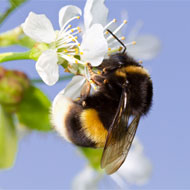
Bees exposed to neonicotinoids collected less pollen
For the first time, scientists have shown that exposure to neonicotinoid pesticides can impair crop pollination by bumblebees.
Bees are vital for pollinating some of the world's most important food crops, but their numbers have been declining in recent years.
Previous studies on pesticides have focused on the impact they have on the bees themselves, rather than their effect on pollination services.
A team of international researchers studied bumblebees that were exposed to realistic levels of neonicotinoid pesticides found in agricultural environments.
They discovered the bees collected less pollen from apple trees and visited flowers less frequently than a control group that were exposed only to a sugar solution containing no pesticides.
Co-author Dr Mike Garratt from the University of Reading said: "This suggests that bumblebees exposed to pesticides must somehow behave differently on flowers."
In addition, apple trees visited by bees that were exposed to pesticides produced 36 per cent fewer seeds - a factor that is closely linked to fruit quality in most apple types.
Another of the authors, Professor Nigel Raine from the University of Guelph in Canada, said: "Bumblebees are major pollinators of apples and many crops around the world.
"The findings of this study have important implications for both society and the economy, as insect pollination services to crops are worth at least $361 billion worldwide every year, and are vital to the functioning of natural ecosystem."
The research has been published in the journal Nature: http://www.nature.com/nature/journal/vaop/ncurrent/full/nature16167.html


 Companies marketing medicines for small pets exempt from authorisation must submit their annual return to the Veterinary Medicines Directorate (VMD) by 30 November 2026.



