


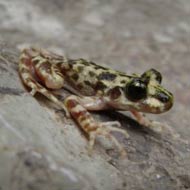
Scientists manage to eliminate deadly fungus in wild amphibians
For the first time, scientists have been able to eliminate a deadly chytrid fungus from wild-living amphibians.
Over a five-year period, the research team combined anti-fungal treatment of Mallorcan midwife toad tadpoles, with environmental disinfection.
Amphibian chytridiomycosis is a disease largely caused by the fungus Batrachochytrium dendrobatidis (Bd). It affects more than 700 amphibian species and has caused plummeting populations and extinctions across five continents.
Co-author Dr Trenton Garner, from the Zoological Society of London, said the findings represent a "major breakthrough" in the fight against Bd.
Previous attempts to eradicate wildlife pathogens in situ have rarely proved successful.
The research team initially tried to eliminate infection through direct application of an anti-fungal treatment. This was successful ex situ but the infection returned once tadpoles cleared of infection returned to their natal sites.
As a result, the team used instead a combination of anti-fungal treatment and environmental chemical disinfection.
In four out of the five pools they worked at, infection was eradicated and remained so for the duration of the study.
Dr Jaime Bosch, a senior researcher at the National Museum of Natural History in Spain, said: "This is the first time that chytrid has ever been successfully eliminated from a wild population – a real positive which we can take forward into further research to tackle this deadly disease.
"Chytrid is a global issue which affects amphibian populations worldwide, and I am proud to be part of a team of leading institutions at the forefront of this pioneering research working towards a solution."
Read the full research paper in Biology Letters: http://rsbl.royalsocietypublishing.org/content/11/11/20150874
Image by tuurio and wallie/Wikimedia Commons/CC BY 3.0


 Companies marketing medicines for small pets exempt from authorisation must submit their annual return to the Veterinary Medicines Directorate (VMD) by 30 November 2026.



