


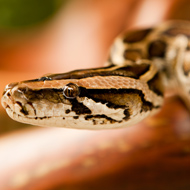
Fatty molecules reduce friction
Fatty molecules on the surface of a snake's belly reduce friction and allow the animals to slither smoothly across surfaces, according to new research.
The discovery could inspire new types of paints, coatings, plastics and other materials that are highly resistant to water.
A snake's skin is slippery and smooth all over, but the scales on its belly are even slicker producing less friction that those on its back. This has always puzzled scientists because the scales do not vary in size or shape and both are covered in a thin layer of fatty molecules.
To find out why the skin on a snake's belly is more slippery, scientists at the Oregon State University tool a closer look at the scales of a California king snake using a high-powered microscope.
They found that on the belly scales, the molecules were lined up in uniform rows and columns, perpendicular to the surface of the scale. The researchers say that it is this orderly boundary layer of lubricant that reduces friction for the California king snake.
Jon Baoi, who led the research at Oregon State University, commented: "It's crazy how well ordered this is. it would be hard for me to believe it is random because you have to work hard to make a well-ordered monolayer."
Scientists have examined the chemistry of snake scales before, but this is the first time that anyone has looked at them with techniques sensitive enough to detect the ordering of molecules on the surface.
The work forms part of a larger collaboration that aims to compare the surfaces of snakes across species and will be presented later this month at the AVS 62nd International Symposium & Exposition in California.


 Companies marketing medicines for small pets exempt from authorisation must submit their annual return to the Veterinary Medicines Directorate (VMD) by 30 November 2026.



