


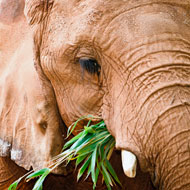
Elephants have more of a gene called TP53
A new study has revealed that elephants have enhanced defences against cancer, the BBC reports.
Scientists at the University of Utah made the discovery while trying to figure out why elephants have lowers levels of cancer than would be expected for their size.
The study, published in the Journal of the American Medical Association, shows that elephants have more of a gene called TP53 which triggers faulty cells to stop growing or self-destruct before they go rogue.
Dr Joshua Schiffman, one of the researchers and a paediatric oncologist, told the BBC: "By all logical reasoning, elephants should be developing a tremendous amount of cancer, and in fact, should be extinct by now due to such a high risk for cancer.
"Nature has already figured out how to prevent cancer, it's up to us to learn how different animals tackle the problem so we can adapt those strategies to prevent cancer in people."
Animals have evolved various ways of fighting cancer including the naked mole rat, which rarely contracts cancer.
However, experts from the Institute of Cancer Research in London argue that studies should focus on why humans have such high levels of cancer.
Professor Mel Greaves told the BBC: "In terms of adaptive mechanisms against cancer we have the same as a chimp, but we get a lot more cancer than a chimp.
"I think the answer is humans are completely unique as a species in having very rapid social evolution in a short period of time."
He pointed to the rise of unhealthy cancer-causing activities such as sunbathing, smoking and obesity.


 Companies marketing medicines for small pets exempt from authorisation must submit their annual return to the Veterinary Medicines Directorate (VMD) by 30 November 2026.



