


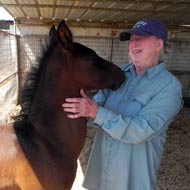
UC Davis celebrates success with ICSI
A foal has been born through in-vitro fertilisation (IVF) at UC Davis vet school in the US. This represents a first for equine medicine at the university.
Equine reproduction specialists used the process of intracytoplasmic sperm injection (ICSI). Unlike traditional IVF (which often doesn't work on horses), this involves injecting a single sperm into an egg extracted from a mare.
Once the embryo has developed in a laboratory for a week, it is implanted in the mare.
Initially, specialists attempted to artificially inseminate Zholani - a thoroughbred-shire mix - using frozen sperm from an Andalusian horse called El Gavilan.
After a few unsuccessful attempts, Dr Bruce Christensen of UC Davis suggested enrolling the mare in his ICSI research study.
Six of Zholani's eggs and El Gavilan's sperm were sent to the Equine Embryo Laboratory at Texas A&M University.
Due to Zholani's previous inability to get pregnant, the team decided to use a recipient mare to carry the pregnancy.
The foal, named 'Lord Nelson' was born at UC Davis' Center for Equine Health. Once he matures, he will begin training for a career in dressage. His owner Carol Alonso is excited about his prospects, based on his carefully selected lineage.
Image courtesy of UC Davis


 Companies marketing medicines for small pets exempt from authorisation must submit their annual return to the Veterinary Medicines Directorate (VMD) by 30 November 2026.



