


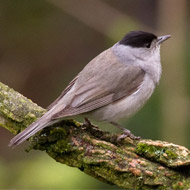
Blackcaps have shifted their migration route
Bird food provided in British gardens has helped Blackcaps to rapidly evolve a successful new migration route, according to a study by the British Trust for Ornithology.
Using data from a 12-year garden bird study, researchers have shown that Blackcaps from Central Europe have shifted their migration route north-west towards Britain, instead of south-west towards Southern Spain.
Speaking to BBC News, lead author Kate Plummer said: "This is the first time that we've shown that feeding birds actually influences the distribution of a bird species across a whole country."
Researchers say that the number of Blackcaps migrating to Britain over the past 60 years has increased significantly and that they are now regular visitors to garden feeding stations.
"We saw that both [climate change and garden feeding] were driving this shift in migration [from the Mediterranean to Britain]," Dr Plummer said. "Where there was a reliable supply of food, blackcaps were more likely to be seen."
During the study, over 14,000 volunteers submitted a weekly record of the birds in their gardens. The researchers observed that wintering Blackcaps in British gardens coincided with the wider introduction of commercial wild bird food.
"So it looks like like they're evolving to adapt to using this big supply of winter food," said Dr Plummer.
Graham Madge, from the RSPB, told BBC News that it was only because "people take such a keen interest" and "monitor birds in these surveys, that we're able to understand the impacts we're having on birds and wildlife".
"It's positive news that blackcap numbers are increasing here, but when it comes to house sparrows and starlings, unfortunately [in these same surveys] we're seeing massive declines," he added.
The study, Is supplementary feeding in gardens a driver of evolutionary change in a migratory bird species?, is published in Global Change Biology.
Image (C) Tony Hisgett/Wikimedia


 Companies marketing medicines for small pets exempt from authorisation must submit their annual return to the Veterinary Medicines Directorate (VMD) by 30 November 2026.



