


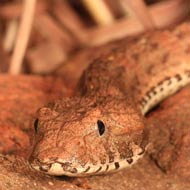
Australian snake is threatened by toad invasion
A new, highly venomous death adder has been discovered in north-western Australia. But scientists say it is under threat from a wave of invasive toads.
The Kimberley death adder - named after the region in which it was found - is a 'sit and wait' predator. It remains camouflaged until it can ambush passing prey.
It is thought to be just one of many currently undescribed species living in west Australia.
A team of UK and Australian scientists identified the species while researching the genetics and ecological traits of snakes living in the region.
Lead researcher Simon Maddock, a PhD student at the Natural History Museum and University College London, said the Kimberley death adder is "probably quite rare" - although it is not yet known how many there are in the wild.
Death adder populations are said to be declining in Kimberley. They are under threat from a wave of highly poisonous cane toads that are making their way across the region.
"There are records of them eating these poisonous cane toads," Mr Maddock said. "It's potentially a big threat."
The research team believe a detailed assessment of the threats facing Kimberley death adders will result in them being listed as a species needing legal protection.
Like other related species, the Kimberley death adder has a diamond-shaped head and a stout body. It can be identified by the slightly higher number of scales on its underbelly. These are typically unpigmented.
Its scientific name 'Acanthophis cryptamydros' comes from the Greek words kryptos (meaning cryptic, hidden) and amydros (meaning indistinct, dim).
To read the research paper, visit: http://www.mapress.com/zootaxa/2015/f/zt04007p326.pdf
Image © Ryan Ellis, Western Australian Museum


 Companies marketing medicines for small pets exempt from authorisation must submit their annual return to the Veterinary Medicines Directorate (VMD) by 30 November 2026.



