


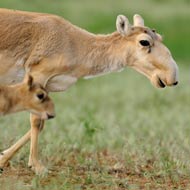
Over 134,000 Saiga died in two weeks this year
A UK charity has launched an emergency appeal to help investigate a mass die-off of critically endangered antelopes.
Earlier this summer, the Saiga Conservation Alliance (SCA) reported that around 134,000 Saiga antelopes had been found dead in less than two weeks in Kazakhstan. This was more than half the global Saiga population.
The exact cause of death remains a mystery, making it impossible to protect the remaining animals. Conservationists fear another die-off could end the species.
Those hoping to save the Saiga are now in a race against time to gather and analyse samples and data. The People's Trust for Endangered Species (PTES), which is based in the UK, is sending emergency funding to SCA to support its urgent fieldwork.
Initial tests have identified two types of bacteria in the stomachs of the deceased Saiga. However, these bacteria are normally harmless, leading experts to believe unknown environmental factors may have made the bacteria deadly, or lowered the Saigas' immunity.
The animals are said to have died a few hours after showing symptoms including diarrhoea and frothing at the mouth. The mothers died after losing the ability to breathe and eat properly, followed by the deaths of the calves a few days later.
Outbreaks are thought to have occurred almost at the same time in four separate gatherings of female Saiga, who give birth in large groups.
SCA's field expedition has so far covered 4000km in Kazakhstan, where a few small surviving herds have been spotted.
Samples and data is now being analysed and the findings and recommendations will be shared at an upcoming conference.
Sadly, this is not the first time a mass die-off has been seen in the species. In 2010, 12,000 of the animals were found dead in a week. However, this remains the largest scale die-off known to date.
For more information visit http://ptes.org/ways-to-give/saiga-emergency-appeal/
Image © Igor Shpilenok/Flickr/CC BY 2.0


 Companies marketing medicines for small pets exempt from authorisation must submit their annual return to the Veterinary Medicines Directorate (VMD) by 30 November 2026.



