


New cases of contagious bee disease
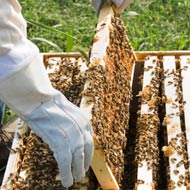
AFB must be dealt with quickly as it can be spread by the honeybees themselves.
Two further cases of a notifiable bee disease have been confirmed in Scotland.
The highly contagious American foulbrood (AFB) was discovered in a honeybee hive in Glen Isla. Investigations traced the source back to another apiary in Coupar Angus in Perthshire.
While the second apiary contained no live bees, the bacteria was found in debris on old frames.
As there is no permitted treatment for AFB, both hives have been destroyed.
Both apiaries also contained European foulbrood (EFB), which had previously been confined mainly to the commercial sector. These bees had recently been purchased from a non-commercial keeper.
Investigations are ongoing to determine whether this case is linked to an earlier outbreak of AFB at another apiary near Alyth in Perthshire.
To date there have been five cases of AFB in Scotland this year, and 60 cases of EFB.
The Scottish Government says the outbreaks present no threat to public health. Neither do they affect the quality or safety of honey.
AFB and EFB are the only two notifiable, bacterial diseases of honeybees. AFB is the most serious and must be dealt with quickly as it can be spread by the honeybees themselves.
Movements of bees and related equipment is being strictly controlled at the affected apiaries.
Bee keepers and farmers in the affected areas are being urged to be particularly vigilant for these diseases and to carry out specific health checks on their bees.
All bee keepers are asked to register on BeeBase, the national bee database.
Further information can be found at: http://www.gov.scot/Topics/farmingrural/Agriculture/animal-welfare/Diseases/disease/brood


 Companies marketing medicines for small pets exempt from authorisation must submit their annual return to the Veterinary Medicines Directorate (VMD) by 30 November 2026.



