


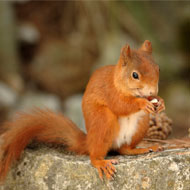
Cases confirmed on Isle of Wight and Brownsea Island
A recent study looking into the decline of red squirrels has revealed cases of leprosy on the Isle of Wight and Brownsea Island.
In a letter published in Vet Record (Vol.177 No.8), Vic Simpson from the Wildlife Veterinary Investigation Centre writes that out of the 163 squirrels examined, four squirrels - three from the Isle of Wight and one from Brownsea Island - showed symptoms of the disease.
The findings demonstrate that red squirrel leprosy in not confined to mainland Britain.
In 2014, a study led by the University of Edinburgh confirmed a new form of leprosy in six red squirrels in Scotland.
The disease is caused by the bacteria Mycobacterium lepromatosis - which is one of the bacteria involved in the human form of leprosy. However, there has been no suggestion that there is any risk to humans.
Not much is known about the spread of the disease, however it is believed to be widespread - infected animals have been found from the Moray Firth to Dumfries and Galloway.
In light of the findings in Scotland, wildlife experts decided to re-examine the four cases on the Isle of Wight and Brownsea Island, even though their symptoms appeared very different.
Although the gross pathology of the squirrels did not closely resemble the disease found in Scotland and the numbers of acid-fast bacilli seen in sections were far less, the researchers say this is possibly because they represent a chronic stage of red squirrel leprosy.
Vic Simpson writes: "Our findings demonstrate that red squirrel leprosy is not confined to mainland Britain. More research is needed into the epidemiology of this novel disease, including its zoonotic potential, but at this stage it is clear that grey squirrels are not implicated the transmission of M lepromatosis as they are not present on the Isle of Wight or Brownsea island."


 Companies marketing medicines for small pets exempt from authorisation must submit their annual return to the Veterinary Medicines Directorate (VMD) by 30 November 2026.



