


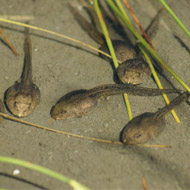
Discovery sheds light on declining frog populations
Scientists at the University of Essex and the Natural History Museum have identified a new and highly infectious tadpole disease in a diverse range of frog populations across the world.
The discovery, published in Proceedings of the National Academy of Sciences, highlights some of the threats facing fragile frog populations which are in decline.
In the study, the scientists tested tadpoles from six countries across three continents for 'protists' - single celled microbes with complex cells which store their DNA in a nucleus (like human cells).
The previously unidentified parasite was present in tadpole livers in both tropical and temperate sites, and across all continents tested. The infectious agent was identified as a distant relative of Perkinsea sp., a marine parasite found in animals and algae.
Professor Thomas Richards from the University of Exeter said: "Global frog populations are suffering serious declines and infectious disease has been shown to be a significant factor. Our work has revealed a previously unidentified microbial group that infects tadpole livers in frog populations across the globe.
"We now need to figure out if this novel microbe - a distant relative of oyster parasites - causes significant disease and could be contributing to the frog population declines."
Amphibians are widely recognised as the most threatened animal groups. In 2008, 32 per cent of species were listed as 'threatened or extinct' and 42 per cent as 'in decline'.
The decline of amphibian populations, particularly frogs, is thought to suggest that Earth is currently going through a sixth mass extinction event.
Image © Wikimedia/Bohringer Friedrich


 Companies marketing medicines for small pets exempt from authorisation must submit their annual return to the Veterinary Medicines Directorate (VMD) by 30 November 2026.



