


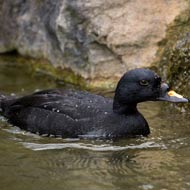
Winter migration tactic confounds researchers
Britain's most threatened breeding duck has been tracked for the first time to find out where it goes in winter. Researchers say their findings offer clues to help this troubled species.
Despite its name, the British common scoter has always been rare and in the past two decades, its population has halved. Only around 40 breeding pairs remain in Britain.
Now, the common scoter is found in just a few parts of the Scottish Highlands.
Researchers from the Wildfowl and Wetlands Trust (WWT) caught and tagged four of the birds last year. It was expected that they would all migrate together, but researchers were taken aback when they found the scoters had all gone to four separate locations.
One migrated to the nearby Scottish coast, another went somewhat further afield to the coast of Morocco, while the remaining two went to different parts of the Irish sea.
WWT's research officer Ed Burrell says this is a survival strategy.
"The fact they stay apart in winter is a bit like the Royal family never flying together," he explains. "It means they can’t all be affected by a single issue like a storm or oil spill. So that means that whatever is causing their decline is more likely to be in the summer when they’re all together in the Highlands."
Common scoters are one of the few British birds about which little is known. Their well-hidden nests in remote areas and the fact that they spend their winters on the sea make them difficult to find and count.
WWT's findings will allow them to "concentrate" their efforts to save the species, Mr Burrell adds.
A partnership of commercial, government and charitable organisations will step up their monitoring work in the Highlands. Nests and feeding areas are being mapped and nest cameras have been installed along with thermometers to record the temperature under egg clutches.
Image attribution: Jason Thompson/Wikimedia Commons/CC BY 2.0


 Companies marketing medicines for small pets exempt from authorisation must submit their annual return to the Veterinary Medicines Directorate (VMD) by 30 November 2026.



