


New technique vital for leopard conservation
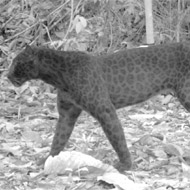
They say a leopard never changes its spots, but the 'black panthers' of Malaysia can certainly hide them. Almost entirely black in colour, these beautiful leopards roam the rainforests of the Malay Peninsula and, because of their colouring, their spots are incredibly difficult to see.
Now, by modifying the infrared flash on automatic camera traps and forcing them into 'night mode', a team of experts from the University of Nottingham have finally revealed them. It is hoped that the study, published in the Journal of Wildlife, will provide scientists with a new tool to help save this unique and endangered animal.
Lead author Laurie Hedges explains: "This is perhaps the only known example of a wild mammal with virtually an entire population composed of black individuals and scientists have no idea why it predominates in the Malay Peninsula. Understanding how Malaysia's leopards are faring in an increasingly human-dominated word is vital."
Gopalasamy Reuben Clements from the University of Nottingham's Malaysia Campus, adds: "Most automatic cameras have an infrared flash, but it's only activated at night. By blocking the camera's light sensor we can fool the camera into thinking it is night even when it is day, so it always flashes."
The black leopard's dark skin is the result of melanism - the over-development of dark-coloured pigment in the skin and the opposite of albinism. The condition makes it nearly impossible to identify individual animals, and for this reason leopard populations in Peninsular Malaysia have been difficult to study. Now their spots have been revealed, the researchers can identify different animals and begin to estimate the population size of the species.
Mark Rayan Darmaraj, who manages a WWF-Malaysia tiger conservation project, comments: "Because their uniformly black colour prevented us from identifying individual animals and thereby estimating their ovulation sizes very little was known about leopards in Malaysia."
Conservation work can now begin across Malaysia and the researchers hope to use their new method to study black leopards elsewhere.
Image (C) Rimba Research Malaysia.


 Companies marketing medicines for small pets exempt from authorisation must submit their annual return to the Veterinary Medicines Directorate (VMD) by 30 November 2026.



