


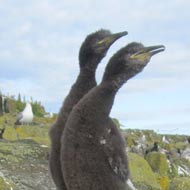
Edinburgh scientists explore wild seabird infections
For the first time, research suggests parasite infections in some wild seabirds can have a serious impact on how well their relatives do - having a greater impact on them than the infected birds themselves.
Scientists from the University of Edinburgh say their findings could also have implications for the conservation of other wild animals.
While it is not clear why infections in some birds can affect others, researchers suggest it may be due to the impact it has on the ability to nurture young, or the fact that infected chicks need more care.
Edinburgh scientists worked with those from the Centre for Ecology and Hydrology. They studied cormorant-like birds during breeding season on the Isle of May National Nature Reserve, off the east coast of Scotland.
Worm infections in parent birds or their nestlings were found to have a greater impact on others in the family group, than the infected birds themselves.
In their experiments, the researchers treated either the parents or chicks with anti-worming injections. They discovered this could have positive results for others in the nest.
When parents were treated, chicks born early in the breeding season had improve survival chances. If chicks born early in the season received treatment, their parents gained weight. Parents of the treated chicks also went on to breed earlier in the next breeding season, giving those offspring a better chance of survival.
However, chicks born later in the season to parents that had received worming treatments were found to have a slightly poorer chance of survival, while the parents of treated chicks born late in the season went our to lose weight.
Scientists suggest this may be due to the fact that those born later are more at risk of secondary infection, and food is in short supply.
Lead researcher Hanna Granroth-Wilding said: "Our knowledge of disease in wild animals has tended to focus on the individual, but our study shows that we need to pay more attention to the broader consequences of disease to fully appreciate the role that it plays in wild populations, especially those whose numbers may be under threat."
Image © Mark Newell


 Companies marketing medicines for small pets exempt from authorisation must submit their annual return to the Veterinary Medicines Directorate (VMD) by 30 November 2026.



