
Your data on MRCVSonline
The nature of the services provided by Vision Media means that we might obtain certain information about you.
Please read our Data Protection and Privacy Policy for details.

In addition, (with your consent) some parts of our website may store a 'cookie' in your browser for the purposes of
functionality or performance monitoring.
Click here to manage your settings.
If you would like to forward this story on to a friend, simply fill in the form below and click send.

Your friend's email:
Your email:
Your name:
 
 
Send Cancel

Model farm goes on display in London
cows
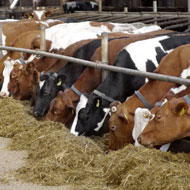
Members of the public can become a 'virtual farmer' using a computer simulation to design a cow diet.
Simulation is the first of its kind in the world

A 'model farm' on display in London this week allows members of the public to design a cow's diet to reduce methane emissions.

As an average cow produces 1000 times more methane than a human, meat production plays an important role in greenhouse gas emissions.

Academics from the University of Bristol teamed up with Rothamsted Research's North Wyke Farm in Devon to show how the sustainable grazing of cows and sheep can contribute to food security in Britain.

The team merged technology with traditional farming techniques to develop the model farm, which is the first of its kind in the world.

It is on display until Sunday 5 July at the Royal Society Summer Science Exhibition, where visitors can become a 'virtual farmer' using a computer simulation to design a cow diet.

'The Real Beef About Meat' exhibit has been put together with Rothamsted Research and the universities of Exeter and Reading.

Professor Michael Lee, head of site at North Wyke, commented: "Likely benefits of designing environmentally optimal livestock grazing systems may include the reduced need for fertiliser application, increased production and nutritional quality, low gas emissions and the support of biodiversity and the provision of ecosystem services.

"There are, of course, possible trade-offs associated with designing livestock grazing systems which need consideration and discussion."

Become a member or log in to add this story to your CPD history

Equine Disease Surveillance report released for Q4 2025

News Story 1
 The latest Equine Disease Surveillance report has been released, with details on equine disease from Q4 of 2025.

The report, produced by Equine Infectious Disease Surveillance, includes advice on rule changes for equine influenza vaccination.

Statistics and maps detail recent outbreaks of equine herpes virus, equine influenza, equine strangles and equine grass sickness. A series of laboratory reports provides data on virology, bacteriology, parasitology and toxicosis.

This issue also features a case study of orthoflavivus-associated neurological disease in a horse in the UK. 

Click here for more...
News Shorts
RCVS annual renewal fee for vets due

RCVS' annual renewal fee for veterinary surgeons is now due. Vets must pay their renewal fee before Wednesday, 1 April 2026.

This year's standard annual fee has increased to 431 from last year's 418. This is an approximately three per cent increase, as approved by RCVS Council and the Privy Council.

Tshidi Gardner, RCVS treasurer, said: "The small fee increase will be used to help deliver both our everyday activities and our new ambitious Strategic Plan, which includes aims such as achieving new legislation, reviewing the Codes of Professional Conduct and supporting guidance, and continuing to support the professions through activities such as the Mind Matters Initiative, RCVS Academy and career development."

A full breakdown of the new fees is on the RCVS website. Information about tax relief is available on the UK government website.

