


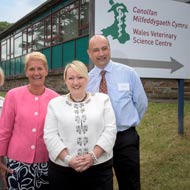
Centre is a 'key step' on the road to a new vet school
The launch of a new veterinary science centre in Wales yesterday (29 June) marked a key step in the road to a Welsh veterinary school, according to the vice chancellor of Aberystwyth University.
Initially the Wales Veterinary Science Centre will carry out post-mortem examinations on farm livestock, but in time hopes to include companion animals and wildlife species too.
It also aims to support both field practitioners and disease eradication programmes by developing a range of diagnostic services.
Christianne Glossop, chief veterinary officer for Wales, said the centre will have a "significant" impact on animal welfare, making an important contribution to the farming industry and reflecting the role of the veterinary profession.
Welsh deputy minister Rebecca Evans officially opened the centre, which is located on the site of the former Animal and Plant Health Agency's (APHA) veterinary investigation centre.
She believes the centre will "significantly strengthen and enhance the important contribution the veterinary profession makes to rural life in Wales and raises standards of animal health and welfare."
It was established by Iechyd Da, a consortium made up of independent veterinary practices, Aberystwyth University and Welsh Lamb and Beef Producers Ltd.
APHA recently appointed the consortium to provide PMEs of new and re-emerging farm animal diseases.
Iechyd Da's director, Phil Thomas, described the centre as a "One Health institute that recognises the interlocking, overlapping relationships between people, livestock, the wildlife and the environment around us."
Aberystwyth University first announced its intention to open a Welsh vet school in October 2013.
Commenting on the launch of the new centre, Aberystwyth's vice chancellor April McMahon said: "The Wales Veterinary Science Centre is an example of integrated, partnership working in areas vital to the Welsh rural economy. It is also a key step towards our ambition of developing a Vet School for Wales in Aberystwyth."
Image courtesy of Aberystwyth University


 Companies marketing medicines for small pets exempt from authorisation must submit their annual return to the Veterinary Medicines Directorate (VMD) by 30 November 2026.



