


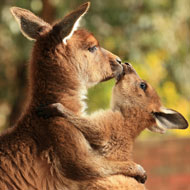
Posture may be key in the origin of handedness
Kangaroos prefer to use their left hand for feeding and grooming, according to a new study.
The findings, published in Current Biology, show for the first time that population-level "handedness" can be found in a species other than humans.
Russian scientists from St Petersburg University travelled to Australia and spent hours watching marsupials in the wild.
They observed two kangaroo species - the eastern grey and the red - as well as the red-necked wallaby, using their left hand to groom, feed or prop themselves up.
Wildlife ecologist Janeane Ingram, who collaborated on the study, explained to the BBC that the findings have not been widely embraced by the scientific community:
"Unfortuantely, even my own colleagues think that studying left-handed macropods is not a serious issue, but any study that proves true handedness in another bipedal species contributes to the study of brain symmetry and mammalian evolution," she said.
Senior author Dr Malaschichev added that in terms of handedness, the study confirmed for the first time that "we are not alone in the Universe; we are two humans and kangaroos".
The researchers argue that posture is an important factor. Handedness has only been seen in species that stand upright on their hind legs, using their forelimbs for tasks other than walking.
Furthermore, the study suggests that upright posture may have been important in the origin of handedness in mammals.


 Companies marketing medicines for small pets exempt from authorisation must submit their annual return to the Veterinary Medicines Directorate (VMD) by 30 November 2026.



