
Your data on MRCVSonline
The nature of the services provided by Vision Media means that we might obtain certain information about you.
Please read our Data Protection and Privacy Policy for details.

In addition, (with your consent) some parts of our website may store a 'cookie' in your browser for the purposes of
functionality or performance monitoring.
Click here to manage your settings.
If you would like to forward this story on to a friend, simply fill in the form below and click send.

Your friend's email:
Your email:
Your name:
 
 
Send Cancel

Bristol leads Hennovation project
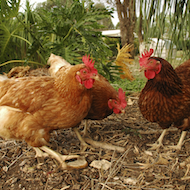
hens
Intiailly, the networks will deal with two issues of particular concern - injurious pecking and the transportation and use of hens that no longer lay eggs.

Networks to tackle issues in the laying hen industry

Bristol vet school is at the helm of a new project which aims to tackle issues of concern in the laying hen industry, through a series of 'innovation networks'.

Recent years have seen huge changes in commercial animal husbandry, as a result of increasingly strict legislation in animal welfare and production sustainability.

Fifteen researchers from five EU countries are involved in the Hennovation project. Up to 20 networks will be set up, supported by vets, farm advisors and scientific researchers, as well as those who buy eggs or certify production.

Intiailly, the networks will deal with two issues of particular concern - injurious pecking and the transportation and use of hens that no longer lay eggs.

David Main, the project's co-ordinator at the University of Bristol’s School of Veterinary Sciences, explained: “Changes in commercial animal husbandry often requires producers and industry to modify existing practices, which creates opportunities for experimentation and innovation.

"With the growing recognition that the traditional model of knowledge transfer from scientific research to industry practice has not always been effective in addressing hoped-for changes in animal welfare and environmental sustainability, a growing emphasis is now being placed on more co-operative forms of knowledge generation and experimental innovation.”

The project also hopes to inspire and support innovation in other livestock sectors.

For more information see http://hennovation.eu/index.html

Become a member or log in to add this story to your CPD history

Equine Disease Surveillance report released for Q4 2025

News Story 1
 The latest Equine Disease Surveillance report has been released, with details on equine disease from Q4 of 2025.

The report, produced by Equine Infectious Disease Surveillance, includes advice on rule changes for equine influenza vaccination.

Statistics and maps detail recent outbreaks of equine herpes virus, equine influenza, equine strangles and equine grass sickness. A series of laboratory reports provides data on virology, bacteriology, parasitology and toxicosis.

This issue also features a case study of orthoflavivus-associated neurological disease in a horse in the UK. 

Click here for more...
News Shorts
RCVS annual renewal fee for vets due

RCVS' annual renewal fee for veterinary surgeons is now due. Vets must pay their renewal fee before Wednesday, 1 April 2026.

This year's standard annual fee has increased to 431 from last year's 418. This is an approximately three per cent increase, as approved by RCVS Council and the Privy Council.

Tshidi Gardner, RCVS treasurer, said: "The small fee increase will be used to help deliver both our everyday activities and our new ambitious Strategic Plan, which includes aims such as achieving new legislation, reviewing the Codes of Professional Conduct and supporting guidance, and continuing to support the professions through activities such as the Mind Matters Initiative, RCVS Academy and career development."

A full breakdown of the new fees is on the RCVS website. Information about tax relief is available on the UK government website.

