


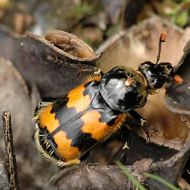
Survival prospects improve with extra care
The survival prospects of young inbred beetles could be improved with extra care from their mother, a study by the University of Edinburgh suggests.
The study, published in the Proceedings of the National Academy of Sciences, shows that the inbred offspring of burying beetles live longer if they are raised by an attentive mother who can protect them from threats.
In this way, maternal care seems too enable the species of the burying beetle to overcome the health disadvantages linked with inbreeding.
Scientists say the discovery could help to explain why some animal species inbreed more than others.
Inbred beetles are often less physically fit, and often live shorter lives, than beetles born to unrelated parents.
The study reveals that maternal care shields inbred beetles from environmental factors - such as predators another species competing for food - which could further reduce their chances of survival.
Maternal care was found to increase the lifespan of inbred beetles, but has no effect on offspring born to unrelated parents.
The team found that inbred beetle larvae, reared by an adult female, were more likely to make it to adulthood than those raised without their mother nearby.
These positive effects continued to benefit beetles even after they had grown up and become independent.
Researchers believe that the protective effects of maternal care are likely to be widespread in other species in which adults raise their offspring.
Lead author of the study, Natalie Pilakouta, said: "It is quite impressive that parents have the capacity to compensate for the negative effects of inbreeding in their offspring.
"These findings can help us understand why some animals don't avoid mating with their relatives."


 Companies marketing medicines for small pets exempt from authorisation must submit their annual return to the Veterinary Medicines Directorate (VMD) by 30 November 2026.



