


Scottish surveillance centre could close in autumn
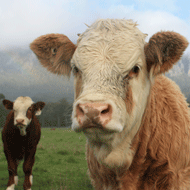
The proposals could represent 'significant' changes to the centres in Inverness and Ayr.
Scotland's veterinary disease surveillance centre in Inverness could close by autumn 2015 if proposed changes go ahead. The move is part of a number of changes now under consultation.
Scotland's Rural College (SRUC) is seeking views from stakeholders on the proposed changes to its network of veterinary disease surveillance centres, which it runs on behalf of the Scottish government.
The proposals could represent 'significant' changes to the centres in Inverness and Ayr, while those at Thurso, Perth, St Boswells, Dumfries, Aberdeen and Edinburgh will continue as normal.
There are however plans to relocate the Aberdeen and Edinburgh centres to new sites close to their present locations.
This announcement follows the Kinnaird Review of Veterinary Surveillance, which was published in 2011, and a consultation with the Strategic Management Board that was subsequently created.
Initially, SRUC says it will consult on future disease surveillance in Inverness and the surrounding area, with one possible option being the centre's closure. The region would then be served by the Thurso, Aberdeen and Perth surveillance centres.
A central diagnostic laboratory is set to open in 2017 on Midlothian's Easter Bush estate, where it will be closely aligned with the University of Edinburgh's Royal (Dick) School of Veterinary Studies.
The lab will also be home to a new Edinburgh veterinary disease surveillance centre. This is in line with recommendations from the Kinnaird Review.
Aberdeen's surveillance centre is set to move to a modern building in Thainstone, close to its current location, or another site in Aberdeenshire in 2017.
In Ayr, the SRUC is proposing to strengthen teaching links with the University of Glasgow's School of Veterinary Medicine.
The consultation will assess whether the Ayr centre should remain in Auchincruive or relocate to another site in the area, or the University of Glasgow's veterinary campus. Routine laboratory testing work at Ayr may be transferred to Dumfries.
Janet Swadling, acting chief executive of SRUC, said: “Against a budget that is reducing in real terms we have prepared a plan to provide a more efficient service which is fit for the future, considers local demands and the need to retain a critical mass of important expertise."
The consultation will run until 10 July 2015. Those wishing to comment on the proposals should contact Brian Hosie, head of SAC Consulting Veterinary Services: brian.hosie@sac.co.uk, 0131 535 3139.


 Companies marketing medicines for small pets exempt from authorisation must submit their annual return to the Veterinary Medicines Directorate (VMD) by 30 November 2026.



