


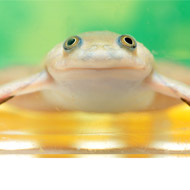
African clawed frog not responsible for spread of lethal infection
A fungus thought to be one of the major drivers of amphibian decline has not been caused by exposure to infected colonies of African clawed frogs, according to research by the Universities of Bristol and Portsmouth.
Amphibian species have been in steady decline for decades. A major cause is thought to be the rapid global spread of a lethal fungus infection Batrachochytrium dendrobatidis (Bd). One prominent theory is that African clawed frogs are responsible for the spread of the disease.
Exported from South Africa worldwide since the 1930s, African clawed frogs (Xenopus laevis) have been used in medical research, human pregnancy testing, and also kept as pets.
It is thought that escaped or released toads infected with the fungus have been involved in spreading the infection to native species. However, this so-called 'out of Africa' theory was originally based on circumstantial evidence and has never been confirmed directly.
Researchers examined the occurrence of Bd in two areas of the UK - Wales and Lincolnshire - where African clawed toads had been released and had established breeding colonies.
Extensive testing of the colonies revealed heavy infections of Bd. However, samples of the frogs, toads and newts gave no evidence of transfer of infection, nor declines in their populations that might have resulted from past disease.
Professor Richard Tinsley from the University of Bristol said the results certainly don't support the 'out-of-Africa' theory in the conditions found in the UK:
“Our field studies provide a particularly robust test of the possibility of disease transfer: the population in Wales was established in the wild over half a century ago, so we would have expected any ill-effects to have become evident here. But, there is still a need for similar comprehensive testing in countries elsewhere in the world where Xenopus has been introduced.
“We still need to understand what prevented the spread of infection from Xenopus in our study areas – potentially including variations between strains of the fungus and natural resistance to these strains by native amphibians. Knowledge of these factors controlling infection may help in regions where spread of the fungus is occurring rapidly.”
The study, ‘Chytrid fungus infections in laboratory and introduced Xenopus laevis populations: assessing the risks for U.K. native amphibians’ is published in Biological Conservation.


 Companies marketing medicines for small pets exempt from authorisation must submit their annual return to the Veterinary Medicines Directorate (VMD) by 30 November 2026.



