
Your data on MRCVSonline
The nature of the services provided by Vision Media means that we might obtain certain information about you.
Please read our Data Protection and Privacy Policy for details.

In addition, (with your consent) some parts of our website may store a 'cookie' in your browser for the purposes of
functionality or performance monitoring.
Click here to manage your settings.
If you would like to forward this story on to a friend, simply fill in the form below and click send.

Your friend's email:
Your email:
Your name:
 
 
Send Cancel

Suspected tumour turns out to be shoelaces
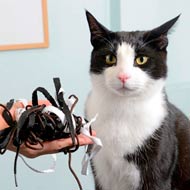
Garry with shoelaces
Vets found shoelaces, hairbands and plastic in Garry's stomach.

Vets shocked to discover a tangle of items in cat's stomach

Brighton vets got a shock when they performed exploratory surgery on a cat with a suspected tumour, only to find an assortment of shoelaces, hair bands and plastic in his stomach.

Curious cat Garry had been taken to PDSA's pet hospital in Brighton for his annual boosters, when vets became concerned by a large mass in his stomach. Garry's worried owner, Ana Barbosa, was told to expect the worst, as a life-threatening tumour was suspected to be the cause.

During emergency surgery, however, PDSA vet Jess Maguire discovered a tangle of objects in Garry's stomach. She commented: "We often see dogs who have eaten odd things, but it is quite unusual for a cat to eat so many different items."

Garry's owner said: "Garry is a very cheeky little chap who has always preferred playing with human things instead of cat toys. But we had no idea he was actually eating them.
 
"I’d washed some laces from my trainers, which went missing. I never for one moment thought that Garry was the reason why!

"When I first heard it may be a tumour, I was devastated. My two boys and I all adore him. So although I was absolutely shocked to find out what the mass was, we were relieved to hear the good news that it wasn’t a tumour."

The items could have caused a fatal blockage if left undetected. Vets suspect they had been eaten over a period of time and said it's surprising the cat had not suffered any symptoms.

Garry's owner said the mischievous moggie will be under close scrutiny now to put a stop to his bizarre snacking.

Image courtesy of PDSA

Become a member or log in to add this story to your CPD history

Equine Disease Surveillance report released for Q4 2025

News Story 1
 The latest Equine Disease Surveillance report has been released, with details on equine disease from Q4 of 2025.

The report, produced by Equine Infectious Disease Surveillance, includes advice on rule changes for equine influenza vaccination.

Statistics and maps detail recent outbreaks of equine herpes virus, equine influenza, equine strangles and equine grass sickness. A series of laboratory reports provides data on virology, bacteriology, parasitology and toxicosis.

This issue also features a case study of orthoflavivus-associated neurological disease in a horse in the UK. 

Click here for more...
News Shorts
RCVS annual renewal fee for vets due

RCVS' annual renewal fee for veterinary surgeons is now due. Vets must pay their renewal fee before Wednesday, 1 April 2026.

This year's standard annual fee has increased to 431 from last year's 418. This is an approximately three per cent increase, as approved by RCVS Council and the Privy Council.

Tshidi Gardner, RCVS treasurer, said: "The small fee increase will be used to help deliver both our everyday activities and our new ambitious Strategic Plan, which includes aims such as achieving new legislation, reviewing the Codes of Professional Conduct and supporting guidance, and continuing to support the professions through activities such as the Mind Matters Initiative, RCVS Academy and career development."

A full breakdown of the new fees is on the RCVS website. Information about tax relief is available on the UK government website.

