


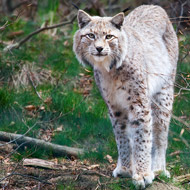
Lynx UK Trust 'blown away' by support
Over 90 per cent of people back the UK lynx reintroduction, according to a public survey carried out by the Lynx UK Trust.
More than 9,000 people took part in the survey, with 91 per cent in favour of a trial reintroduction and 84 per cent believing it should begin within the next 12 months.
Dr Paul O' Donoghue, chief scientific advisor to the project, said that the Trust was 'blown away' by the level of interest and support from the public.
“This is by far the biggest survey of its kind ever carried out in the UK, with almost five times the feedback of the original beaver reintroduction survey in Scotland which recorded an 86 per cent approval rating," said Paul. "That led to government approval for the trial reintroduction, so we're expecting to see a consistent response from Scottish Natural Heritage and hope for similar in England and Wales.
"The UK public have spoken; people overwhelmingly want these animals to be given the chance to come back and we've got an extremely capable team to deliver it."
The Lynx UK Trust announced their hopes to carry out a trial reintroduction of Eurasian lynx to the UK seven weeks ago. Wiped out in the UK over 1,300 years ago by fur hunters, lynx have been successfully reintroduced across Europe.
The team hope that reintroduction in the UK will provide a 'valuable natural control' on the UK's overpopulated deer species, leading to the regeneration of forests and a boost to the entire ecosystem.
The Trust add that Lynx have proven themselves across Europe to be completely harmless to humans and of very little threat to livestock.
Encouraged by the results, Lynx UK Trust are continuing public consultation and education activities. They are also preparing formal applications for trial reintroductions at sites across the UK with one of the world's largest law firms, Clifford Chance.
Applications are expected to be completed by summer for sites in Norfolk, Cumbria, Northumberland and Aberdeenshire. The Trust are still evaluating potential release sites in Wales.
Up to six lynx would be released at each site and closely monitored via satellite collars over a trial period which is expected to last for three to five years.
Image (C) Lynx UK Trust


 Companies marketing medicines for small pets exempt from authorisation must submit their annual return to the Veterinary Medicines Directorate (VMD) by 30 November 2026.



