


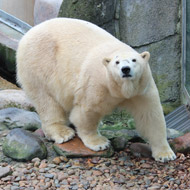
Hopes she will produce the next generation of polar bear cubs
A female polar bear will today (25 March) be welcomed into Highland Wildlife Park in Kincraig, Scotland. She will join resident males Walker and Arktos, with the hope they will produce cubs in the future.
Victoria is arriving from Aalborg Zoo in Denmark, but was originally born in December 1996 at Rostock Zoo in Germany. She will be the only female bear currently in the UK.
Douglas Richardson, head of living collections for Highland Wildlife Park, said: “We are delighted to welcome a female polar bear to the Highlands. Victoria will need to settle in, but visitors should be able to meet our new arrival in a couple of weeks.
"Her enclosure is completely separate to Walker and Arktos’, as male and female polar bears live separately in the wild. During the polar bear breeding season, which general falls between March and May, we will gradually introduce her to Arktos and the two will stay together until the two hopefully mate, when the male will be returned to the bachelor enclosure."
Victoria's enclosure will feature a large pond and plenty of natural ground for her to roam. In addition to the main enclosure, there is an adjacent smaller holding enclosure with its own pool that will initially house the male until the signs are right for the introduction.
"This extra enclosure allows us to also use a visiting male from another zoo should the breeding programme recommend it," Douglas added. "We are not aware of any other polar bear breeding facility that has this degree of flexibility."
A polar bear has not been born in the UK for many years, so Highland Wildlife Park hope that their novel approach to enclosure design, and the correspondingly unique husbandry regime, will translate into success.
"The birth and rearing of polar bears cubs will be of real value to the regional breeding programme, help to highlight the plight of polar bears in the wild, and will be incredibly positive for Highland Wildlife Park,” Douglas said.
Victoria previously gave birth to cubs in 2008. Her first cub, Milak, became an online sensation when hundreds of thousands of people from all over the world followed the early days of the cub's life. It was one of the first times that webcams were able to show what life is like with a mother and a newborn cub.
The last female polar bear to reside in the UK was Mercedes, who died in April 2011 at the age of 30. She was rescued from certain death in Canada in the early 80s, when she came to live at Edinburgh Zoo, before later moving to Highland Wildlife Park, where she was eventually joined by Walker.
Image (C) Highland Wildlife Park


 Companies marketing medicines for small pets exempt from authorisation must submit their annual return to the Veterinary Medicines Directorate (VMD) by 30 November 2026.



