


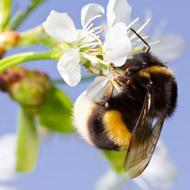
Study reveals that viruses can spread easily between pollinator species
A network of viruses, previously associated with managed honeybees, may now threaten wild bumblebees, according to a study led by the Royal Holloway University of London.
Published in the Journal of Animal Ecology, the study shows multiple interconnected diseases that pose a widespread risk to several species of bumblebee and the managed bumblebee, which are essential pollinators of many wild flowers and agriculture crops.
Professor Mark Brown from Royal Holloway's School of Biological Sciences said: "Our results confirm a recent review of potential threats to pollinators, indicating that so-called called honey bee viruses are widespread in wild bees. It is imperative that we take the next step and identify how these viruses are transmitted among honeybees and wild bees, so that we can manage both to reduce their risk of diseases."
A survey of 26 sites across Great Britain identified five viruses - deformed wing virus, black queen cell virus, slow bee paralysis virus, acute bee paralysis virus and sac brood virus.
Some of these infection levels were highest in honeybees and for others they were highest in bumblebees, suggesting that some viruses are predominately spread by honeybees, while others rely on wild bumblebees.
Dr Dino McMahon from Queen’s University, Belfast, said: “Our findings are important because they indicate that many viruses can spread easily between pollinator species and, furthermore, that they can reach very high disease levels in wild bumblebees.”
Professor Robert Paxton, also from Queen’s University, added: “Our previous research suggested that a key virus of the honeybee – deformed wing virus – spills over to infect bumble bees, probably via contact at flowers. We now find that other viruses may be doing the same. Yet our new findings also highlight just how little we know of bee parasites and the role they play in the decline of pollinators.”


 Companies marketing medicines for small pets exempt from authorisation must submit their annual return to the Veterinary Medicines Directorate (VMD) by 30 November 2026.



