


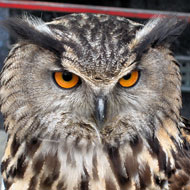
A rogue owl is forcing the residents of a Dutch town to carry umbrellas at night for protection.
Over the past three weeks, the European eagle owl has terrorised the northern town of Purmerend, swooping down on people and causing head injuries in some cases.
Purmerend City Council has advised people to carry umbrellas in the evening to protect themselves.
Liselotte de Bruijin is a spokesperson from a local home for people with disabilities. She told the AFP news agency that residents and staff have experienced 15 separate attacks.
"During the day there's no problem, but at night we now only venture outside armed with umbrellas, helmets and hats, anything really, to protect ourselves," she added.
European eagle owls usually prey on small mammals and birds. According to the Dutch owl foundation, the bird's aggression may be due to heightened hormones as breeding season begins.
Alternatively, it could be down to the fact that it is believed the owl was raised in captivity and has learnt to associate people with food.
Gejo Wassink from the foundation told AFP: "Either the owl was reared in captivity and released into the wild and now associates humans with food – meaning it’s not really ’attacking’ people.
"Or it may have heightened hormone levels as the breeding season starts, which influences its behaviour and makes it defend its territory."
Mr Wassink highlighted the issue of people hand-rearing owls then releasing them into the wild when they can no longer cope with them.
In a statement on its website, the city council said: "We want to capture the eagle owl because the safety of our citizens is at risk." However, the owl is a protected species so this process usually takes some time.
The European eagle owl is one of the world's largest owl species, with a wing span of up to 6ft and weight of up to 3kg.
Image: Wikimedia Commons/CC BY 2.0/John Haslam


 A nationwide roadshow offering free, personalised parasite risk assessments and flea and tick checks will be visiting popular dog events across the UK.



