


Evolution favours larger sea creatures
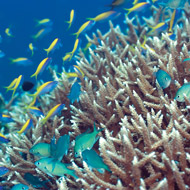
The study provides fresh support for Cope's rule - a theory that states that animal lineages tend to evolve towards larger sizes over time.
Animals tend to evolve toward larger body sizes over time, according to a study by Stanford University.
New research, published in the journal Science, has revealed that over the past 542 million years, the mean size of marine animals has increased 150-fold.
"That's the size difference between a sea urchin that is about two inches long versus one that is nearly a foot long," said Noel Heim, a postdoctoral researcher at Stanford's School of Earth, Energy & Environmental Sciences. "This may not seem like a lot, but it represents a big jump."
The scientists also discovered that the increase in body size is not due to all animal lineages steadily growing bigger. Instead, it is due to the diversification of groups of organisms that were already larger than other groups early in the history of animal evolution.
"That's also something we didn't know before," said Jonathan Payne, a paleobiologist at the school. "For reasons that we don't completely understand, the classes with large body size appear to be the ones that over time have become differentially more diverse."
One of the most comprehensive studies of body size evolution ever conducted, the study provides fresh support for Cope's rule - a theory that states that animal lineages tend to evolve towards larger sizes over time.
Scientists have attempted to test Cope's rule in other animal groups, but the results have been mixed. Dinosaurs and corals seem to follow Cope's rule, however birds and insects do not.
The scientists say that the findings could help those studying other questions related to body size - for example whether organisms on the equator are, on average, bigger or smaller than those living at higher latitudes.
The findings could also prompt other scientists to investigate whether there is a trend in the evolution of other traits.
Jonathan said: "The discovery that body size often does evolve in a directional way makes it at least worth asking where we're going to find directionality in other traits if we measure them carefully and systematically."


 Companies marketing medicines for small pets exempt from authorisation must submit their annual return to the Veterinary Medicines Directorate (VMD) by 30 November 2026.



