


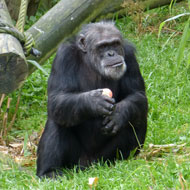
New research refutes long-held assumptions about chimp vocalisation
Chimps can adapt their vocalisations to match those of their companions, after developing strong friendships. This is according to new research by the University of York, which refutes previous assumptions that these vocalisations are fixed.
Chimpanzees have distinctive grunts for different types of food, which can be understood by other chimps. It has long been assumed that vocalisations by non-human primates simply relate to a state of arousal - for example the level of excitement or preference for certain foods. Scientists have argued that this is the key difference between language and the vocalisations made by non-human primates.
However, new research published in Current Biology suggests otherwise.
In 2010, a group of adult chimps from Beekse Bergen Safari Park in the Netherlands were integrated with chimps from Edinburgh Zoo. York researchers, led by Dr Katie Slocombe, examined whether the structure of their food calls could be changed.
Prior to integration, the two groups had different grunts, as well as different preferences for, apples. Researchers made acoustic recordings of the chimps' grunts for apples before the groups were integrated, in 2011 after integration, and again in 2013.
According to the findings, the Dutch chimps altered their grunts so that three years after the groups were first integrated, their grunts were very similar to those of the Edinburgh chimps.
However, the research team say that simply living together for two years and being exposed to the Edinburgh group's grunts was not enough to change the structure of the calls made by the Dutch chimps. It was not until 2013, when analysis of social networks suggested strong friendships between members of the groups, that the grunts changed.
Significantly, the chimps' preference for apples did not change. Researchers say this shows the calls are not due simply to a state of arousal, but can be altered regardless of the animal's preference for the food.
Dr Slocombe said: "An extraordinary feature of human language is our ability to reference external objects and events with socially learned symbols, or words. These data represent the first evidence of non-human animals actively modifying and socially learning the structure of a meaningful referential vocalisation."
Co-author Dr Simon Townsend from the University of Zurich, said the findings could shed light on the evolutionary origin of the human ability to acquire words through social learning.
"The fact that both humans and now chimpanzees possess this basic ability suggests that our shared common ancestor living over six million years ago may also have been socially learning referential vocalisations."
Image © Jamie Norris


 Companies marketing medicines for small pets exempt from authorisation must submit their annual return to the Veterinary Medicines Directorate (VMD) by 30 November 2026.



