


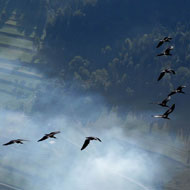
RVC researchers discover birds take in in turns to lead the flock
Birds flying in V formation share the burden of flying up front, according to new research by the Royal Veterinary College (RVC).
In a previous study, RVC researchers found birds can save energy by flying in the aerodynamic 'upwash' produced by the birds in front of them. In fact, birds could save more than 50 per cent on energy costs, compared to flying solo. Birds leading the V formation therefore use the most energy.
So how do the flock decide who flies in front? In a new study published in the Proceedings of the National Academy of Sciences (PNAS), the RVC aimed to find out why birds still change their position and fly in the lead, rather than just staying at the back.
Selection pressure should mean birds minimise their energy use to increase their chance of survival - particularly young birds migrating for the first time. Mortality rates are considerably higher during the bi-annual long-distance migration, partly due to the necessary physical exertion.
Researchers used miniature GPS and motion sensing loggers to track a flock of juvenile northern bald ibis's during a human-guided migration.
According to the findings, pairs of the birds took it in turns to lead the formation, matching the time spent leading and at the back. Researchers say the flock shared the benefits of the energy-saving upwash.
In the report published in PNAS, the authors said this flight behaviour offers "a convincing example of reciprocal altruism in animals".
To read the full report, visit: http://www.pnas.org/content/early/2015/01/30/1413589112.full.pdf+html
Image ©Waldrappteam


 Companies marketing medicines for small pets exempt from authorisation must submit their annual return to the Veterinary Medicines Directorate (VMD) by 30 November 2026.



