


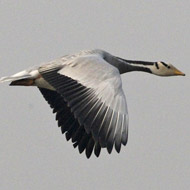
Decreasing air density at higher altitudes reduces bird's ability to produce lift
Geese adopt a 'roller coaster' strategy during high altitude flights across the Tibetan plateu and Himalayan Mountains, a study by Bangor University has revealed.
Led by Dr. Charles Bishop from the School of Biological Sciences, the research team used custom-designed data loggers to monitor pressure derived altitude, body accelerations and heart rate of bar-headed geese during their southern migration from their breeding grounds in Mongolia to their wintering grounds in South-easter Tibet or India.
The study showed that geese perform a sort of roller coaster ride through the mountains, essentially tracking the underlying terrain - even if it means repeatedly shedding altitude only to have to regain height later in the same or subsequent flight.
The scientists say that the birds adopt this strategy as flying at progressively higher altitudes becomes more difficult, as the decreasing air density reduces the bird's ability to produce the lift and thrust required to maintain flight. The birds are also faced with a reduction in oxygen availability as the atmospheric pressure falls from 100 per cent at sea level to around 33 per cent at the top of Mt. Everest.
Robin Spivey, the Research Officer on the project and developer of the data logging equipment, said: “We have developed two independent models to estimate changes in the energy expenditure of birds during flight”.
“One based on changes in heart rate and one based on the vertical movements of the bird’s body. These indicate that, as even horizontal flapping flight is relatively expensive at higher altitudes, it is generally more efficient to reduce the overall costs of flying by seeking higher-density air at lower altitudes.”
The paper, 'The roller coaster flight strategy of bar-headed geese conserves energy during Himalayan migrations, by Charles M Bishop et al', is published in Science.
Image (C) Lip Kee


 Companies marketing medicines for small pets exempt from authorisation must submit their annual return to the Veterinary Medicines Directorate (VMD) by 30 November 2026.



