


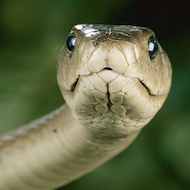
Anti-venom could prevent thousands of snakebite deaths
Scientists from the Liverpool School of Tropical Medicine have been awarded Medical Council Research (MRC) to fund research into a universal anti-venom to treat victims of the most venomous snakes in the sub-Saharan Africa.
Led by Dr Robert Harrison from the School's Venom Unit, the research team will develop a single, affordable anti-venom for the whole region. They intend to develop this anti-venom so that it can be stored safely at ambient temperature, avoiding the need for refrigeration.
Around 32,000 people die from snakebites in the sub-saharan Africa every year. With the 'universal' anti-venom, the scientists hope to prevent many of these deaths, as well as help the 96,000 people who are left permanently disabled after surviving snakebite.
Commenting on the project, Dr Harrison said: “There are over 20 species of deadly snakes in sub-Saharan Africa and doctors often rely on the victim’s description of the animal to help them decide which treatment to administer.
"The preferred option therefore is to give a broad-spectrum, or poly-specific, anti-venom to cover all the possible snake species that could be responsible. Because these treatments are generally not very effective against any one species, the doctor therefore administers many vials. However, each dose carries a risk of serious side effects and this risk increases with each additional vial.”
Currently, the need to give many vials to treat a victim of snakebite not only increases the chance of side-effects, but often makes treatment unaffordable in rural areas of sub-Saharan Africa where people are at the greatest risk.
The anti-venom will be manufactured using a system developed in Costa Rica which is considerably cheaper than most anti-venom manufacturers, reducing costs by up to three quarters and making it affordable to rural African communities.
Dr Harrison added: “Snakebite has often fallen outside the tropical infections remit of many international funding agencies. MRC support therefore represents important recognition that snakebite is a very serious public health concern to some of the world’s most impoverished communities.
"It also, magnificently, provides us with the opportunity of using novel scientific techniques to develop an anti-venom for sub-Saharan Africa that should be unparalleled in its effectiveness, safety, storage and affordability to those rural African snakebite victims that need it the most.”


 Companies marketing medicines for small pets exempt from authorisation must submit their annual return to the Veterinary Medicines Directorate (VMD) by 30 November 2026.



