
Your data on MRCVSonline
The nature of the services provided by Vision Media means that we might obtain certain information about you.
Please read our Data Protection and Privacy Policy for details.

In addition, (with your consent) some parts of our website may store a 'cookie' in your browser for the purposes of
functionality or performance monitoring.
Click here to manage your settings.
If you would like to forward this story on to a friend, simply fill in the form below and click send.

Your friend's email:
Your email:
Your name:
 
 
Send Cancel

Farmer forced to cull aggressive cows
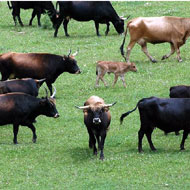
heck cows
Heck cows are the result of an attempt to bring back the extinct Auroch.

Herd of "super cows" in Devon are descended from those bred in Nazi Germany

A farmer has been forced to cull part of his herd of Heck cattle, which are descended from cows bred for aggression in Nazi Germany.

Derek Gow imported 13 Heck cows from Holland and Belgium back in 2008. It was the first time they had ever been imported into Britain.

Mr Gow has had to cut his herd down to six cows due to their aggressive and dangerous nature.

He told The Guardian: "The ones we had to get rid of would just attack you any chance they could. They would try to kill anyone. Dealing with that was not a lot of fun at all.

"I have worked with a range of different animals from bison to deer and I have never come across anything like these. They are by far and away the most aggressive animals I have ever worked with.

"Some were perfectly calm and quiet and they are the ones we have kept. The others you could not go near."

Heck cows are the result of an attempt to bring back the extinct Auroch, which is often confused with the European bison.

Two German zoo directors, Heinz and Lutz Heck, tried to revive the species in the 1920s, an attempt that was supported by Hermann Goering, head of Hitler's Luftwaffe. Within a few generations, the pair managed to breed calves that had a similar appearance and ferocity to the Auroch.

While most Heck cows were destroyed after the Second World War, some survived.

Image courtesy of Derek Gow.

Become a member or log in to add this story to your CPD history

Equine Disease Surveillance report released for Q4 2025

News Story 1
 The latest Equine Disease Surveillance report has been released, with details on equine disease from Q4 of 2025.

The report, produced by Equine Infectious Disease Surveillance, includes advice on rule changes for equine influenza vaccination.

Statistics and maps detail recent outbreaks of equine herpes virus, equine influenza, equine strangles and equine grass sickness. A series of laboratory reports provides data on virology, bacteriology, parasitology and toxicosis.

This issue also features a case study of orthoflavivus-associated neurological disease in a horse in the UK. 

Click here for more...
News Shorts
RCVS annual renewal fee for vets due

RCVS' annual renewal fee for veterinary surgeons is now due. Vets must pay their renewal fee before Wednesday, 1 April 2026.

This year's standard annual fee has increased to 431 from last year's 418. This is an approximately three per cent increase, as approved by RCVS Council and the Privy Council.

Tshidi Gardner, RCVS treasurer, said: "The small fee increase will be used to help deliver both our everyday activities and our new ambitious Strategic Plan, which includes aims such as achieving new legislation, reviewing the Codes of Professional Conduct and supporting guidance, and continuing to support the professions through activities such as the Mind Matters Initiative, RCVS Academy and career development."

A full breakdown of the new fees is on the RCVS website. Information about tax relief is available on the UK government website.

